Pages

Monday, March 6, 2017

Breed Profile #2: Shetland Sheep

I'm still working on editing photos from my visit to True Colors Farm in Washington, ME last week.  Brenda, the owner of the farm, was kind enough to look at some of my photos and tell me what breeds her sheep are so that I can do a couple breed profiles!

Today, I have a few random facts for you about Shetland Sheep!


These sheep are really, really old.  Well, not the sheep in the above photo...I mean that the breed is old.  :P  Shetland Sheep have existed on the Shetland Islands for over 1000 years, thriving despite the harsh climate.


Shetland Sheep are on the smaller side, ranging from 75-125 pounds.  They're described as calm, charming, easy to handle...and intelligent.  Huh.  I'm not sure I've ever heard of any sheep breed that was considered intelligent!


They come in a zillion colors and patterns (or 11 and 30, if you want to be precise).  I was quite delighted by the list of patterns - it includes words like "Bersugget," "Bronget," "Flecket," "Gulgomet," and "Smirslet."  I think that the above sheep may be "Katmoget" patterned - but do NOT hold me to that!!

Shetland Sheep are one of the only breeds that can produce a fleece so black that it doesn't need any additional dye.  


Shetland wool is known for being particularly fine and soft - traditionally, the finest fibers were used to make a lace shawl that could be pulled through a ring - and the coarser fibers could be used for socks, outerwear, and tapestry yarns.  This was a huge industry for the Shetland Islands at one point.


I thought this was interesting - Shetland Sheep are considered a "primitive" (unimproved) breed, and many will naturally lose their fleece each year.  This can be hand collected when it's loose enough (called "rooing").  Or they can be shorn as you would do with other sheep.

So...there's a little bit about Shetland Sheep!  I like the sound of them - maybe someday I'll have a few Shetlands on Butterscotch Farm!  People would be welcome to come help me roo them.  :P


My research sources:


Friday, March 3, 2017

Oops...

Oops.

Guess what happens when you boil maple sap too long...

(I'm sure some of you know the answer!)


You get maple sugar!! 

Yep, I'm not entirely certain where I went wrong, but my last batch of maple sap went past the syrup stage and firmly into the candy stage - this stuff was SOLID!  I had to microwave it to loosen it up enough to chip it out of the bowl.  


It was a very yummy mistake, though.  I'll try it in my coffee tomorrow morning.

And maybe I should find the candy thermometer before I boil more sap...

Wednesday, March 1, 2017

Breed Profile #1: Llamas

I'm hoping to visit a variety of farms and learn more about how a farm works, as well as collect information on various breeds of farm animals.

I figured I'd do a breed profile for each kind of animal I meet - it'll help me to do some research, and hopefully people will find the facts and photos interesting.  :)  

Please keep in mind that I'm just researching these animals fairly quickly and compiling facts from a variety of sources; if you see a wrong fact or feel that I'm missing something important I ought to know about the breed, please let me know!

All photos are my own unless otherwise noted.

So...on to Breed Profile #1: Llamas!


So in my last post I detailed my Scotch Collie's herding evaluation at True Colors Farm in Washington, ME.  That was the main event, but the owner did give me permission to walk around and take photos of some of her animals.  She has at least one horse, a couple dozen sheep...and llamas.

I'll admit that this is an animal I haven't really thought about having on my farm, so it's been interesting doing research on the breed.

Llamas are related to camels, but don't have a hump.  They stand around 47 inches at the shoulder, and can weigh 250 pounds or more.  They chew their cud like a cow.


They originated in South America, and are right up there as one of the longest-domesticated animals.  They have relatives in the wild but do not naturally live in the wild themselves.

In their native countries, their primary use is as a pack animal; they can carry 50-75 pounds over a distance of twenty miles a day.  Their endurance, thirst resistance and ability to graze a wide variety of foliage make them very valuable in their native climate.

Their wool is used for making ropes, rugs and fabric; their hide is sometimes turned into leather; their dung is dried and used as fuel; and they can be used for meat.


What possible benefits are there for modern, American farmers in keeping llamas?

-Their wool can be used, though it's not as fine as alpaca wool.  Some people are breeding llamas for better wool type and production.  The lack of lanolin in the wool is beneficial for people with allergies.
-They make a good pack animal; their hooves don't destroy trails like many other animals.
-They are fairly easy and inexpensive to keep - they only need minimal shelter, they eat mostly what sheep eat, and they don't challenge fencing.
-They can be used for meat.
-They can be helpful in a rotational grazing plan, as they can thrive on poor quality grazing.
-They can be used as a livestock guardian.


Keep in mind that if you plan to use a llama as a livestock guardian, there are definite pros and cons, the number one con being that llamas themselves are prey animals and cannot face down a heavy predator load.  For a really excellent article on this subject, click here.

That being said, Brenda at True Colors Farm tells me that she hasn't had coyotes kill any of her animals since she got the two llamas pictured above!  When I approached the fence, the llama got to its feet to watch me, and all the sheep gathered behind it.  It kept a close eye on my while I was wandering around taking pictures.

So...my take on llamas...well, frankly, I'm not particularly attracted to them at this point, but it was very interesting to research them!  

Below are some of the sources I found helpful if you'd like to do more reading:


Monday, February 27, 2017

Thane Got to Meet SHEEP!!

The first thing I want to say is an apology for how many photos are in this blog post...but, hey, it could be worse - I took 169 photos today, but I've pared it down to only around 20 - give or take a few - to share with you.  :P

And then I want to say that THANE AND I GOT TO MEET SHEEP TODAY AND THANE HAD A HERDING EVALUATION AND I GRABBED A SHEEP BY ITS WOOL!!!

Ahem.

Anyway, to begin at the beginning, I've been looking for a place for quite some time where I could have Thane evaluated for herding instincts.  I'm not even sure I want to pursue actual lessons at this point, with livestock probably still at least a couple years away for me, but (being rather obsessed with my dog) I just wanted to see how Thane would do around sheep.

I talked with Thane's breeder, and she recommended True Colors Farm in Washington, Maine - she took Thane's sire there for some training a while back.  So I looked it up, and a few emails later, Thane and I hit the road and made the three-hour trek east!

Thane sees the sheep.

The sheep see Thane.
 
Brenda and her Border Collie, Josie, show us how it's done.

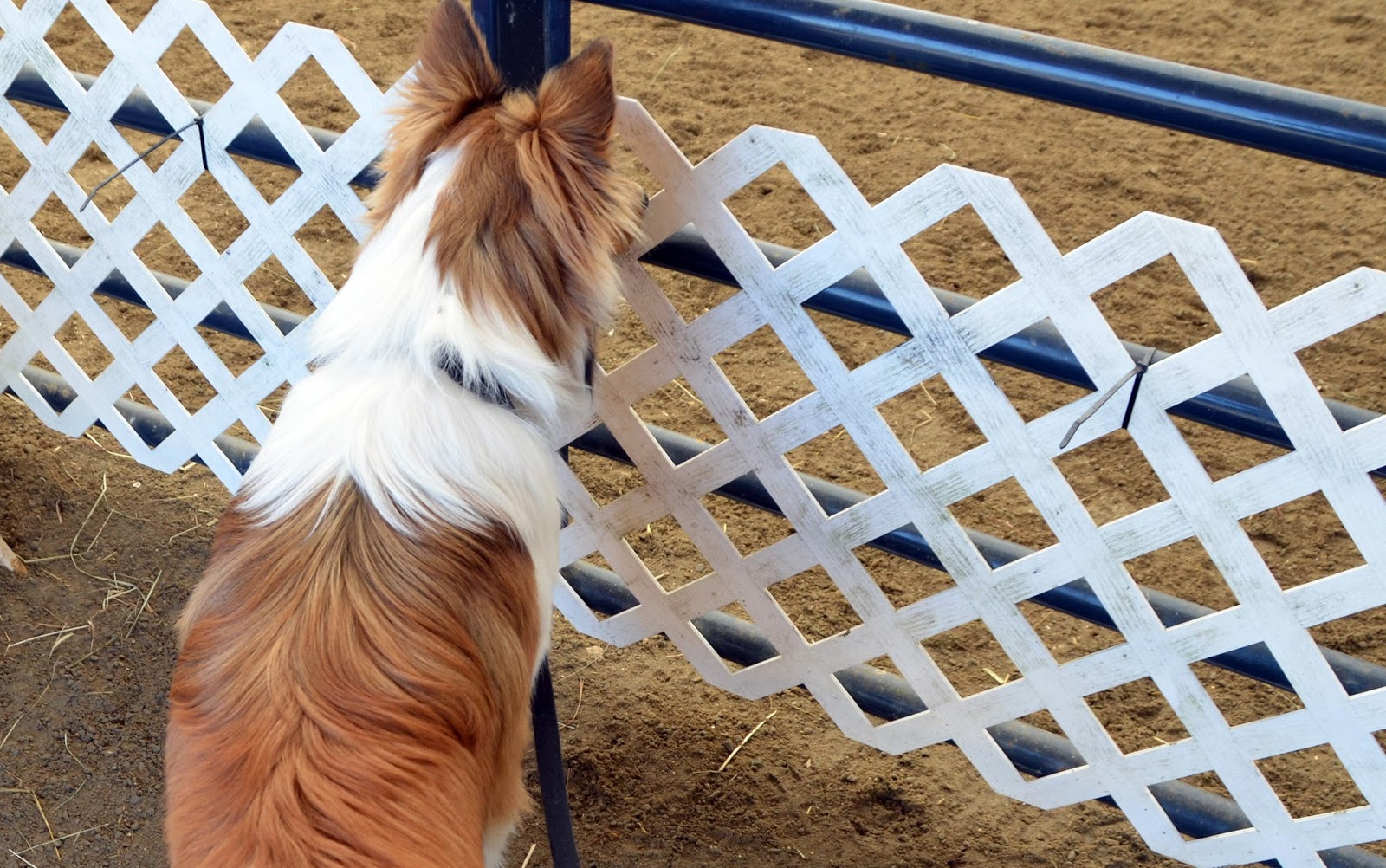
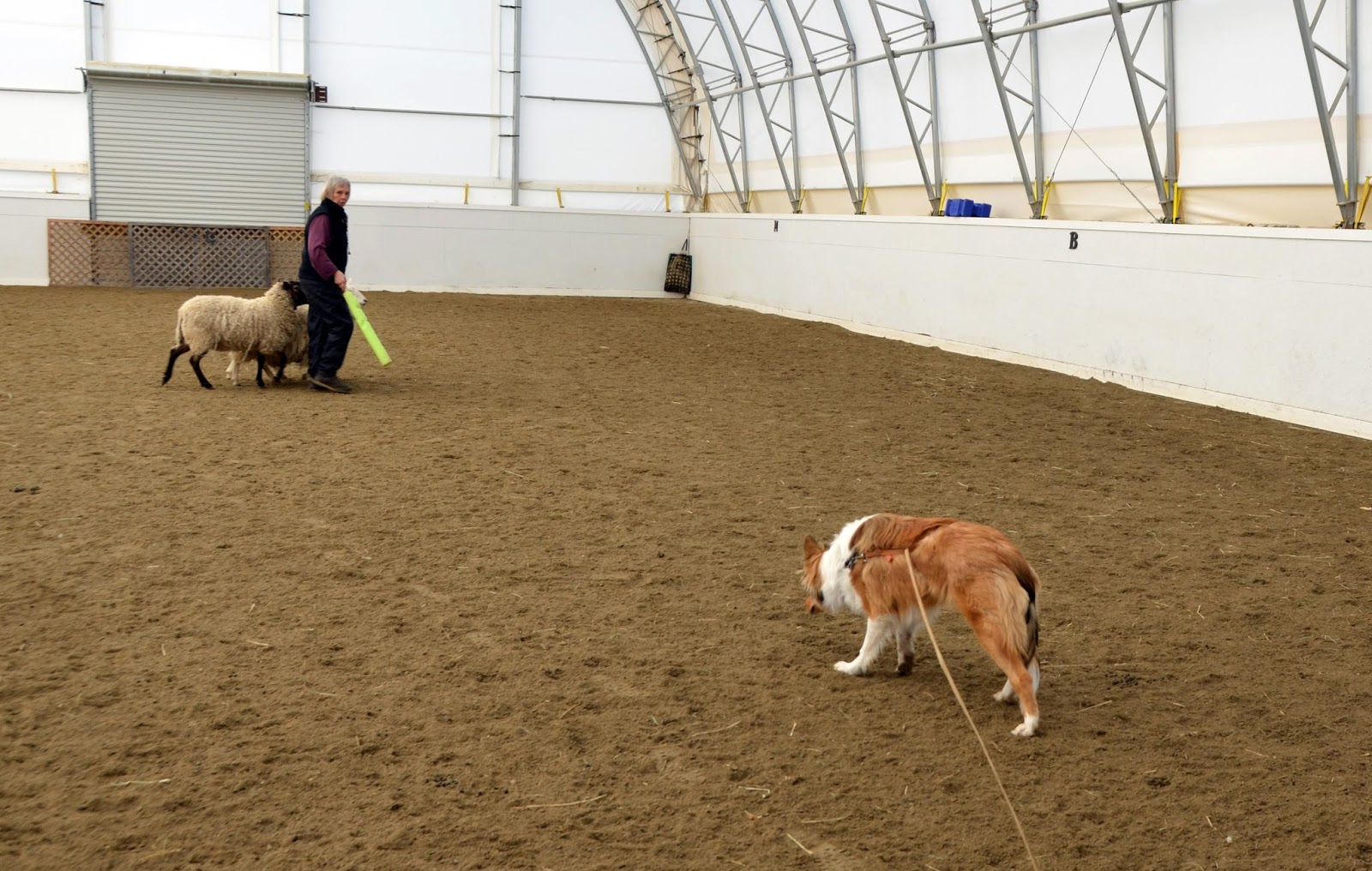
Thane is curious but nervous - tail between his legs, hanging back.

Getting a little more bold...

Whoops, nope!  Too scary!
 
A little more focused...

And then kind of "herding," and kind of just puppy zoomies.

Brenda uses the stick to keep Thane from hanging out with her.

She has to watch out for sheep, especially with an erratic puppy in the ring.

These sheep are well-broke and will stay close to Brenda.

Thane pauses to dissect a chunk of wool - best toy ever!!

Easily distracted.

Nice moves, Bud.

Kind of doing what he's supposed to be doing...

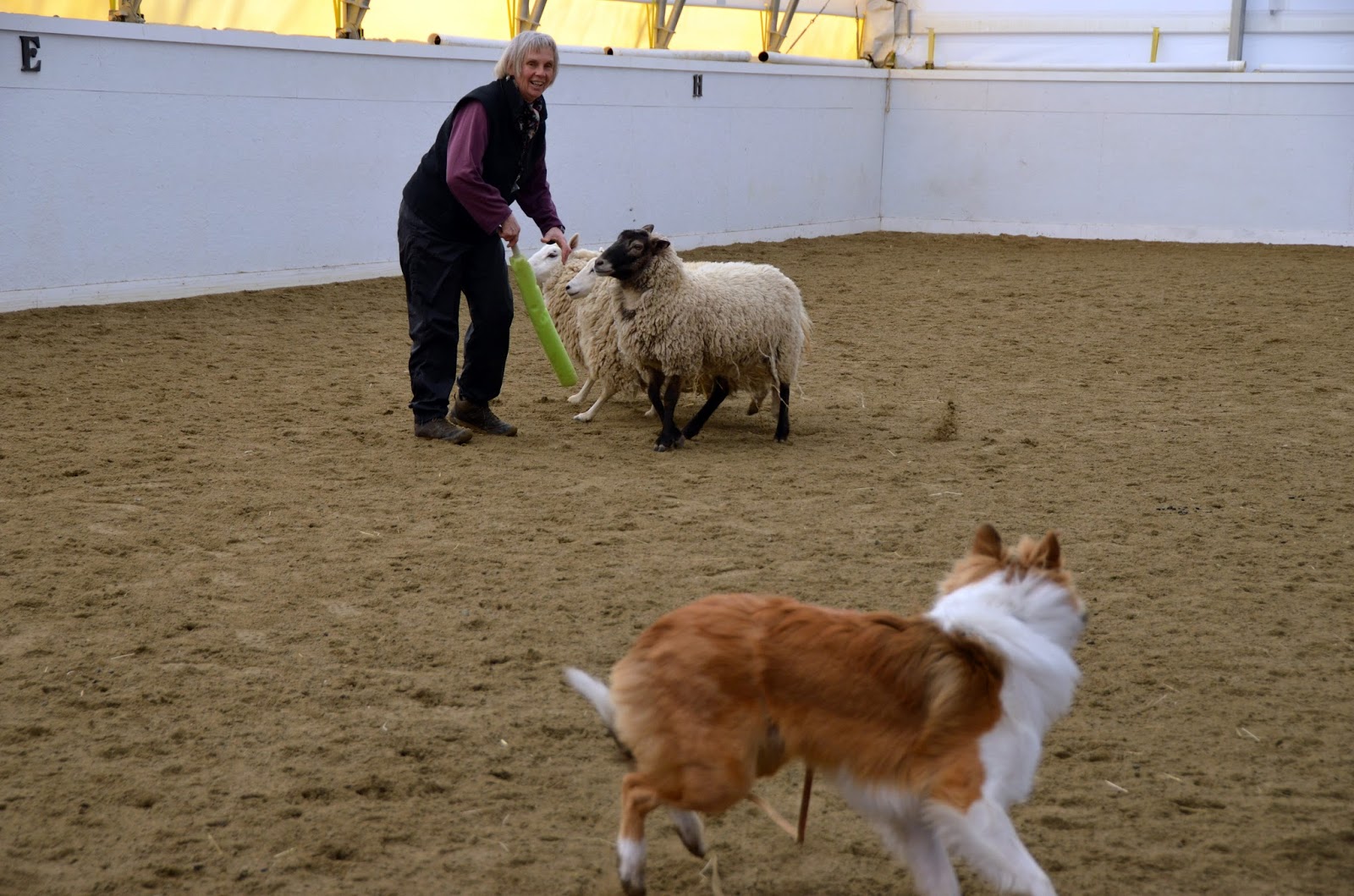
Flying Collie!

Brenda keeping him where he belongs.


Aaand slowing down.
Thane had three different brief sessions in the ring; the second two were with sheep that were less broken and wouldn't stick close to Brenda - both to save her knees, and to try to encourage Thane to chase them.  At this point his instincts are not yet fully "awakened."  Brenda did say, however, that he didn't seem to be just chasing the sheep for fun - rather, he was trying to catch them, and was going for their heads.  I'm under the impression that that's a good start.  :P

I'm going to let him grow up more and try again in a couple months.  It was a fun experience, though.  I'll be showing you other photos from around the farm over the next few days, but for now, have a couple Border Collie photos.  Another lady brought her two Border Collies for some troubleshooting...I admit that I couldn't see their flaws - it's so amazing to watch them work!

This is Doz:


And Brook:


Thane's herding style won't be quite like theirs, but it'll be really cool if someday he's as talented and responsive as these beautiful dogs!

Saturday, February 25, 2017

Turning My Sap into Syrup

So since my last post, we've collected probably several gallons of maple sap from our two trees.  The sap flow is slowing down now, but I'm curious if it'll pick back up in a few days when the overnight temperatures drop back down below freezing - we've been experiencing an unseasonably warm week!


So far I've been pretty happy with the spiles and tubing, but if I were to do this on a larger scale, I'd almost certainly buy the more traditional metal spiles and the lidded metal buckets that hook onto the spiles - as the snow melts, the plastic jugs keep sinking lower.  In fact, this morning, the jug on the far right in the above photo had dropped so low that the tube popped out.  


And this one hangs in the air until it's got enough sap in it to weigh it down.  :P

On Thursday, I had a bit of time before work and started boiling some of the sap down.  Friday, I got started nice and early.


This is what it looks like when you get started - perfectly clear.  I drank a cup straight from the collection jug - it just tasted like sugar water (and apparently, it has lots of health benefits!!  See this link for more information.)


This pot had been boiling for a little while - the color is starting to change.


And this is what I had started to boil on Thursday.  From what I understand, it's fine to pause the boiling at any point and store the partially-boiled sap in the fridge, then put it back on the stove when it's convenient.

You can also keep adding fresh sap when the pot has boiled down some.  So I did that all yesterday morning, boiling the sap and gradually adding more until, by the time I had to leave for work, it was all in two pots.

My amazing sister-in-law, Becky, babysat the boiling pots for me after I went to work, eventually combining them both into one pot when they had boiled low enough.  

When I came home from work, THIS was on the stovetop:


It's so pretty!!  :)  

Now I just need to strain it, and then I can refrigerate it or can it.  

This has been an excellent adventure, and I'm sure I'll do it again next year!  :D

Monday, February 20, 2017

Tapping My Maple Trees

I had a good day off from work - I got a few things done, but it still felt relaxed.

A friend and I took our dogs for a walk in the woods.  The little dog's name is Dexter, and he's a cute little guy...I was impressed with his enthusiasm for tennis balls, even though he can barely hang onto them.


He and Thane got along quite well, actually, mostly ignoring one another after the initial greeting, which was fine by me.  At obedience class, Thane tends to be super excited to see the other dogs, so it was good to see that he is capable of settling down after a bit.


In the afternoon, I decided to go ahead with a project I've been thinking about for a long time - tapping a couple of the maple trees on our property.  I bought four spiles and a length of tubing last week, and with the weather we've been having, I thought I'd check to see if the sap was flowing.


I'm just doing these two trees, since this is more of a fun experiment than anything.  The one on the left is a Sugar Maple (at least, I think it is, lol.  :P ) and I'm pretty sure the one on the right is a Silver Maple.  


I dug a path...


...and drilled a couple holes (thanks for loaning me your drill, Dad!!),  And, yes!  The sap started flowing almost immediately!


I got this kind of spile.  It's less expensive, and it's only 5/16th of an inch instead of the more common 7/16th, so it's supposed to be a little better for the tree (thanks for finding me a 5/16th drill bit, Dad!!).


My one tip - attach the tubing to the spile before you pound the spile into the tree!  I put the first spile in by itself, and it was challenging to attach the tube to it.  (Thanks for finding me empty containers, Dad!!)

I had everything all set up in the early afternoon.  I went out about 5:30 or 6 this evening to empty the containers because I probably won't have time to check on them in the morning - and look how much sap we already got!


As I understand it, I'll have to collect roughly ten gallons of sap in order to end up with one quart of maple syrup.  I'm not sure if I'll try to get that much...but I'm having a blast so far!  I'll keep everyone posted on how the boiling down process goes.  :)